Electronic Logbooks and Digital Equipment Management
Why Electronic Logbooks Are Replacing Paper in Life Sciences Manufacturing
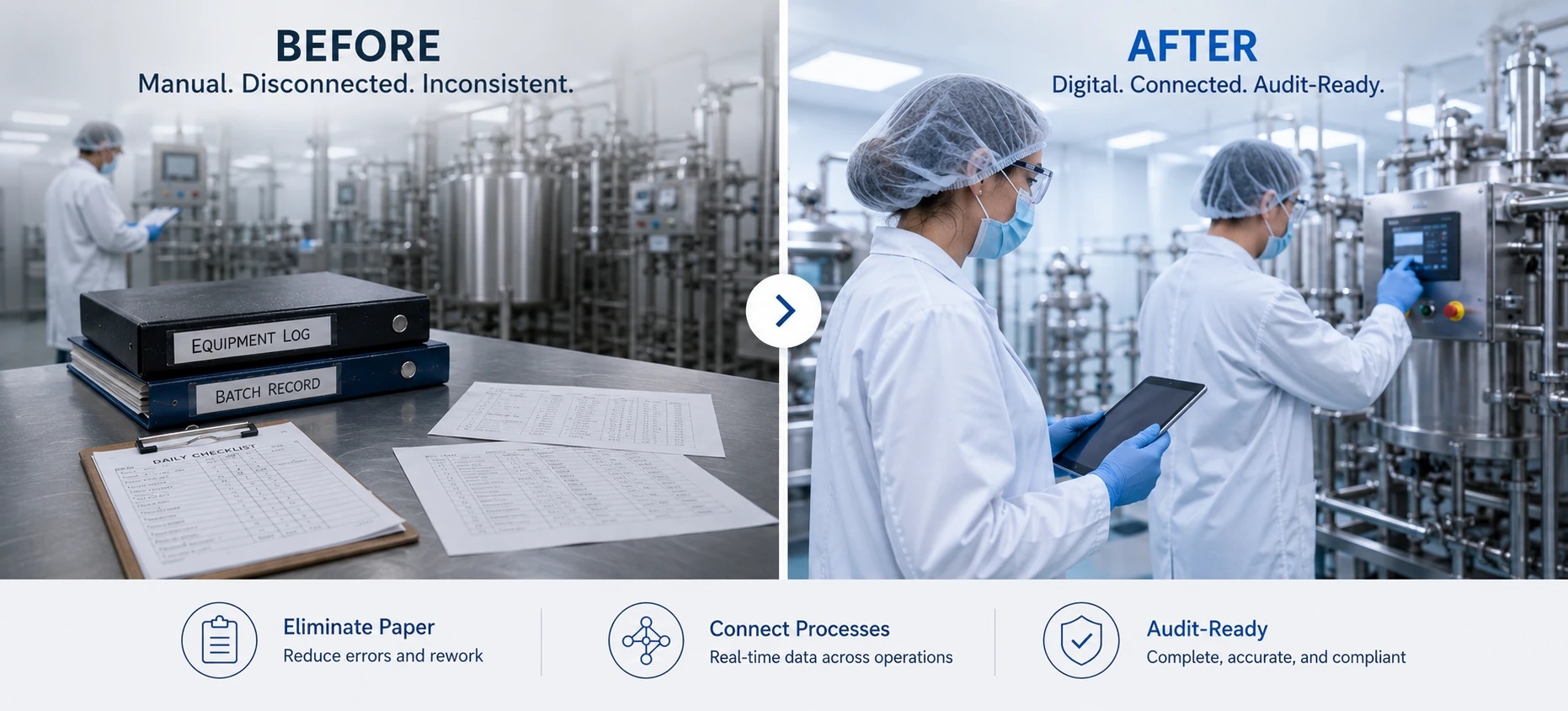
Walk into almost any pharmaceutical or biotech manufacturing facility, and you’ll still find paper logbooks, binders, clipboards, and handwritten records used to track equipment usage, cleaning activities, maintenance, and production operations.
For decades, paper-based documentation has been the standard. But as regulatory requirements grow more demanding and manufacturing operations become more complex, the limitations of paper are becoming increasingly difficult to ignore.
Missed entries, illegible handwriting, delayed updates, and incomplete records create inefficiencies that impact both productivity and compliance. In highly regulated life sciences environments, even minor documentation errors can result in investigation delays, audit findings, or compliance risks.
As a result, many organizations are asking a critical question:
Is there a better way to manage operational records while improving compliance, efficiency, and data integrity?
The answer for many manufacturers is electronic logbook software.
The Problem with Paper-Based Documentation
Paper logbooks introduce inefficiencies throughout manufacturing operations. Operators must manually record activities while managing equipment and processes, which can lead to inconsistent or incomplete documentation. Supervisors and quality teams then spend valuable time reviewing records, resolving discrepancies, and locating missing information.
The challenge often becomes even greater during audits, when teams must gather documentation from multiple locations and verify that records are complete and accurate.
Some organizations have attempted to solve these issues with custom-built applications or generic low-code platforms. However, these solutions frequently require extensive configuration, validation, maintenance, and user training, making adoption difficult and delaying value.
How Electronic Logbooks Improve Manufacturing Operations
Electronic logbooks do more than digitize paper forms. They transform how operational data is captured, managed, and used.
Instead of relying on manual records, teams gain access to real-time, centralized data that is structured, searchable, and readily available across the organization.
For equipment management, this means usage, cleaning, and maintenance activities can be recorded as they occur. Historical records are instantly accessible, giving teams better visibility into equipment status while reducing time spent searching for information.
Electronic logbooks also strengthen GxP compliance by embedding key controls directly into daily workflows. Features such as time-stamped entries, electronic signatures, automated audit trails, and role-based permissions help support data integrity and inspection readiness without adding unnecessary administrative burden.
Driving Consistency and Data Quality
Even well-trained teams can document information differently, creating variability across shifts, departments, and sites.
Electronic logbooks help standardize execution through structured workflows, required fields, and consistent data capture. This reduces transcription errors, minimizes missing information, and improves record accuracy.
The result is more reliable documentation and greater confidence in operational data.
Why Adoption Is Increasing
Historically, many organizations delayed moving away from paper because digital solutions were often difficult to use. Systems that required extensive training or significantly changed established workflows created resistance among end users.
Modern platforms such as OpsTrakker eLogBook address this challenge with purpose-built functionality designed specifically for life sciences manufacturing. By providing ready-to-use workflows and an intuitive user experience, organizations can implement electronic logbooks faster and with less disruption.
Beyond Compliance: Unlocking Operational Insights
The greatest advantage of electronic logbooks is not simply eliminating paper. Once data is captured digitally, it becomes a valuable source of insight.
Manufacturing and quality teams can identify trends, investigate deviations more efficiently, share information across sites, and make more informed operational decisions. What was once static documentation becomes a foundation for continuous improvement.
Moving Forward
As regulatory expectations around data integrity continue to increase, the limitations of paper logbooks become more apparent.
Electronic logbook software provides a practical path to modernizing manufacturing operations by improving equipment tracking, strengthening compliance, and increasing data consistency. For pharmaceutical and biotech organizations pursuing digital transformation, replacing paper logbooks is often one of the simplest and most impactful places to start.