Why AI in Pharma Manufacturing Fails Without the Right Data Foundation
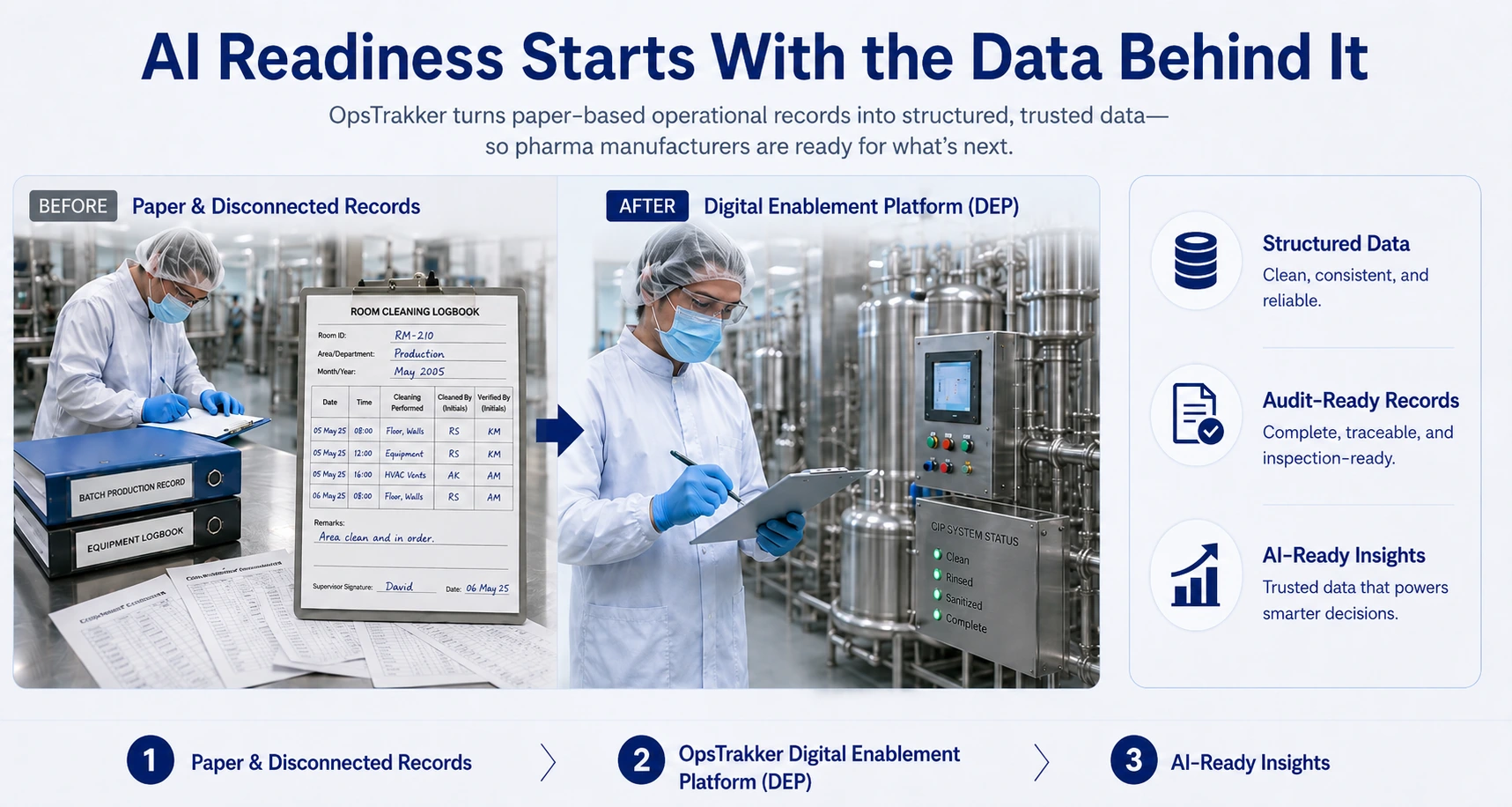
AI Readiness Starts With the Data Behind It
Artificial intelligence is becoming one of the biggest conversations in pharma manufacturing.
Predictive maintenance. Faster deviation investigations. Automated batch review. Better visibility across sites. The potential is real.
But there is one issue that gets overlooked.
Most manufacturers are not short on AI ideas. They are short on usable data.
In a GMP environment, AI cannot be built on scattered logbooks, inconsistent spreadsheets, handwritten notes, disconnected forms, and tribal knowledge. Before AI can improve decisions, the data behind those decisions needs to be complete, structured, contextual, and trustworthy.
That is where many AI in pharma manufacturing initiatives run into trouble.
AI readiness in pharma manufacturing starts with data, not algorithms.
Why this matters now
AI investments in pharma manufacturing are accelerating. Companies are exploring new ways to improve operations, reduce manual review, identify trends faster, and support better decision-making across manufacturing and quality.
But many AI initiatives stall for a simple reason.
The underlying data cannot support them.
In many facilities, critical operational data still lives in paper records, manual logs, disconnected forms, and inconsistent processes. The information may exist, but it is often difficult to search, trend, analyze, or connect to other systems.
That creates a gap between AI ambition and operational reality.
Organizations that address data structure and data integrity early will be in a better position to scale AI later. Those that skip the foundation often end up turning an AI project into a data cleanup project.
What is a Manufacturing Data Foundation?
A manufacturing data foundation is the structured, consistent, and contextual data layer that supports operations, compliance, analytics, and AI.
In pharma manufacturing, this means data is captured in a standardized way, tied to the right process, reviewed when required, and available for reporting, trending, investigation, and future AI use cases.
A strong manufacturing data foundation helps answer practical questions:
- Who captured the data?
- When was it captured?
- What equipment, room, batch, product, or process does it relate to?
- Was the record reviewed or approved?
- Was anything changed after entry?
- Is there an audit trail?
- Can the data be trusted during an inspection or investigation?
Without this foundation, AI has very little to work with.
The Data Problem Behind AI in Pharma Manufacturing
Pharma manufacturing looks highly structured from the outside.
There are approved procedures, controlled workflows, equipment records, batch records, quality systems, and training requirements. Every process is documented. Every record matters.
But inside daily operations, a different picture often appears.
A lot of critical manufacturing data is still captured in places that are difficult to use for analytics or AI, including:
- Paper logbooks
- Manual checklists
- Shift notes
- Operator comments
- Standalone spreadsheets
- Disconnected digital forms
- Informal follow-up actions
The information may exist, but it is often incomplete, inconsistent, or difficult to connect across processes.
That creates a major problem for AI.
AI does not just need more data. It needs better data. It needs structure, context, and trust. In pharma manufacturing, it also needs data integrity.
Why Data Integrity Matters for AI
Data integrity in pharma manufacturing is not just a compliance topic. It is an AI readiness topic.
AI-generated insights need to be explainable, traceable, and based on reliable inputs. If the source data is incomplete or inconsistent, the output becomes difficult to trust.
This matters because regulated manufacturers cannot rely on a black box answer without understanding where the data came from and whether it can be defended.
If an AI model identifies a trend, recommends an action, or supports an investigation, the organization needs confidence in the records behind that output.
That confidence starts with structured manufacturing data.
What is Structured Manufacturing Data?
Structured manufacturing data is data captured in a consistent format, with the right business and process context.
It is not just a scanned form.
It is not just a note typed into a free-text box.
It is not just an electronic version of a paper record.
Structured manufacturing data is organized in a way that makes it usable. It can be searched, filtered, trended, reviewed, reported, and connected to other systems.
In a pharma manufacturing environment, structured data may include:
- Controlled fields instead of open-ended text
- Standardized forms and workflows
- Required data entry where needed
- Time, user, equipment, and process context
- Audit trails
- Review and approval status
- Links to related records
- Data that can support reporting and integration
This is the difference between digitizing a record and creating a data asset.
MES Does Not Capture Everything
Many organizations assume their existing systems already provide the data needed for AI.
MES, LIMS, ERP, CMMS, and QMS platforms all play important roles. They capture major parts of the manufacturing, quality, laboratory, maintenance, and business process landscape.
But they do not capture everything.
MES platforms are typically focused on core manufacturing execution and batch-level activity. LIMS manages lab and testing data. ERP supports planning, inventory, and financial processes. QMS manages quality events and controlled quality workflows.
The challenge is that a lot of day-to-day operational work happens between those systems.
That work often includes:
- Equipment usage logs
- Cleaning records
- Room status checks
- Line clearance forms
- Preventive maintenance support records
- SOP-driven checklists
- Shift handover notes
- Production support activities
- Manual quality checks
- Ad hoc operational workflows
These activities may not justify a full MES build, but they still generate important manufacturing data.
When those processes remain on paper or in disconnected tools, the organization loses visibility. The data may be captured for compliance, but it is not always usable for improvement, analytics, or AI.
MES vs Paper vs Digital Enablement Platforms
Different tools solve different problems.
MES captures core manufacturing execution, but it does not always reach every operational workflow.
Paper can capture flexible day-to-day activity, but it is difficult to search, trend, analyze, or connect to other systems.
A Digital Enablement Platform, or DEP, fills the operational gap by digitizing everyday workflows in a structured, usable format.
That gap matters.
It is where many paper-based records still live. It is where operators complete routine checks, log equipment activity, document process conditions, and capture the operational details that do not always fit neatly into larger enterprise systems.
For AI, that gap is often where the missing context lives.
A DEP is not a replacement for MES, LIMS, ERP, or QMS. It is a practical layer for capturing the operational data those systems do not always reach.
Paper to Digital Pharma Is Not Just a Compliance Project
Moving from paper to digital pharma operations is often viewed as a compliance or efficiency initiative.
That is true, but it is also a data strategy.
Every paper logbook, checklist, and manual form represents a source of operational data. When those records are digitized correctly, they can support much more than recordkeeping.
They can help teams:
- Identify recurring equipment issues
- Spot trends across shifts or sites
- Reduce manual review effort
- Improve deviation investigations
- Find process bottlenecks
- Support continuous improvement
- Prepare for future AI use cases
This is why electronic forms and logbooks in pharma manufacturing have become more valuable than a simple replacement for paper.
The real value comes from capturing operational data in a way that is consistent, searchable, reportable, and ready for future use.
Why AI projects Stall Without Data Readiness
AI projects often struggle because the use case is chosen before the data is ready.
A team may want predictive insights, automated recommendations, or faster investigations. But when they begin looking at the available data, they discover gaps.
The data may be inconsistent across sites.
Important fields may be missing.
Operational context may live in comments.
Paper records may need to be manually reviewed.
Different teams may describe the same process in different ways.
At that point, the AI project becomes a data cleanup project.
This is why data readiness for AI in pharma needs to happen earlier.
Before selecting an AI tool, teams should ask:
- Which operational processes still rely on paper?
- Where does MES stop and manual work begin?
- Which records are difficult to trend or search?
- Are logbooks and forms standardized across teams?
- Can data be trusted for audit, review, and inspection?
- Is the data structured enough to support analytics or AI?
These questions may not sound as exciting as AI, but they determine whether AI can succeed.
Where OpsTrakker Fits
OpsTrakker is designed for the operational gap between enterprise systems and daily GMP execution, where data is created but often not structured or usable.
MES platforms play a critical role in manufacturing execution. But they are not designed to capture every operational detail. In many facilities, important work still happens in paper logbooks, manual checklists, spreadsheets, and disconnected workflows.
OpsTrakker helps digitize that space.
As a Digital Enablement Platform, OpsTrakker replaces paper-based and disconnected operational records with structured digital workflows. This includes electronic logbooks, forms, checklists, and GMP records that are easier to review, manage, trend, and connect.
The goal is not to replace MES, LIMS, ERP, or QMS.
The goal is to digitize the work those systems do not reach.
With OpsTrakker, manufacturers can build a stronger manufacturing data foundation by:
- Replacing paper logbooks with electronic logbooks
- Standardizing digital forms and checklists
- Capturing data at the point of entry
- Preserving user, timestamp, equipment, and workflow context
- Creating audit-ready records
- Making operational data easier to search, report, and analyze
- Supporting integrations with surrounding systems
This creates a more complete view of manufacturing operations.
It also gives AI initiatives a better starting point.
From Compliance Records to Operational Intelligence
Pharma manufacturers already generate valuable operational data every day.
The issue is that too much of it is trapped in formats that are hard to use.
When data is captured in a structured digital format, it becomes more than a completed record. It becomes a source of operational intelligence.
Teams can begin to see patterns that were previously hidden.
They can compare performance across shifts, rooms, assets, products, and sites. They can understand where delays occur. They can identify which processes create the most manual effort. They can improve investigations with better context.
This is the foundation AI needs.
Not perfect data.
Practical, structured, trusted data.
The Path Forward for AI in Pharma Manufacturing
AI will continue to shape the future of pharma manufacturing.
But the companies that benefit most will not be the ones that simply adopt AI the fastest. They will be the ones that prepare their operations for it.
That starts with the data foundation.
Across manufacturing operations, teams need to digitize the workflows that still depend on paper, disconnected tools, and inconsistent manual processes. They need to capture data in a way that supports compliance today and intelligence tomorrow.
MES, LIMS, ERP, and QMS systems will continue to play critical roles. But AI readiness also depends on the processes between those systems.
That is where many of the most important operational details live.
And that is where structured manufacturing data begins.
AI will not transform pharma manufacturing on its own.
The real transformation happens when the data behind AI reflects how operations actually run.
Learn How OpsTrakker Can Kickstart your AI Initiatives
Ready to see OpsTrakker in action? Contact us today to learn how OpsTrakker can set you up for AI in your Manufacturing Operations.