What Is a Digital Enablement Platform? The Missing Layer in Pharma Operations
A Practical Layer for Digitizing GMP Operations
Pharmaceutical manufacturers have made significant investments in digital systems.
MES, LIMS, QMS, ERP, CMMS, BMS, historians, and other enterprise platforms all play important roles in modern manufacturing operations. These systems help manage production, quality, laboratory data, maintenance, facilities, business processes, and automation.
But even with these systems in place, paper still remains across many GMP workflows.
Operators still complete logbooks. Teams still document room cleaning. Supervisors still review checklists. Quality teams still rely on supporting records to understand what happened on the floor. Shift handovers, equipment checks, cleaning verification, and manual inspections are often handled through paper forms, spreadsheets, or disconnected digital tools.
These workflows may seem routine, but they contain important operational data.
They show what happened, when it happened, who performed the activity, what equipment or room was involved, whether the task was reviewed, and whether any follow-up was needed.
When this information remains on paper, it is difficult to search, trend, review, analyze, or connect to the rest of the manufacturing operation.
That is where a Digital Enablement Platform, or DEP, provides value.
A DEP helps pharma manufacturers digitize the everyday GMP workflows that often sit between paper, people, equipment, and enterprise systems. It turns operational records into structured, audit-ready data that can support compliance, visibility, analytics, and future AI readiness.
What Is a Digital Enablement Platform?
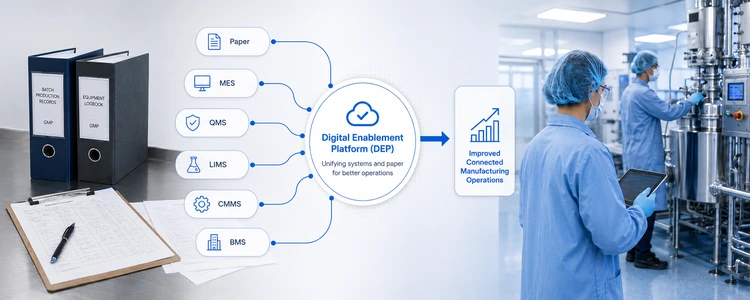
A Digital Enablement Platform is a digital operations layer designed to capture, manage, and standardize GMP workflows that are often handled through paper, spreadsheets, or disconnected tools.
In pharmaceutical manufacturing, a DEP helps teams replace manual logbooks, forms, checklists, and operational records with governed digital workflows.
The goal is not simply to make paper electronic.
The goal is to capture operational data in a way that is structured, traceable, reviewable, and useful beyond the completed record.
A DEP can support workflows such as:
- Equipment logbooks
- Room cleaning records
- Line clearance checklists
- Shift handover forms
- Cleaning verification records
- Daily checks and inspections
- Operational forms and checklists
- Preventive maintenance support records
- Supporting context for deviations and investigations
Instead of treating each workflow as a separate digitization effort, a DEP provides a consistent framework for how GMP data is captured, reviewed, managed, and connected across operations.
Why Pharma Manufacturing Needs a DEP
Many pharma manufacturers have already digitized major parts of their operations.
But there is often a gap between core enterprise systems and the reality of day-to-day work on the floor.
That gap is where paper tends to survive.
It survives because many workflows are highly specific. Some are site-specific. Some are tied to equipment, rooms, cleaning processes, inspections, or local procedures. Some involve multiple departments. Others are too small or too flexible to justify a large system implementation.
The result is a familiar pattern.
A company may have strong enterprise systems in place, but still rely on binders, clipboards, spreadsheets, shared folders, and manual review for important GMP processes.
A DEP addresses this gap by giving teams a practical way to digitize these workflows without forcing every operational record into a system that was not designed for that purpose.
It creates a controlled digital framework for the work that happens across manufacturing, quality, maintenance, facilities, and operations.
DEP and Enterprise Systems: Different Roles, Better Together
A Digital Enablement Platform is not meant to replace the systems pharma manufacturers already rely on.
MES, LIMS, QMS, ERP, CMMS, BMS, and other platforms each serve important roles. A DEP complements these systems by digitizing the operational workflows that often surround them.
For example:
- MES may manage core production execution, while a DEP captures supporting logbooks, checks, and operational forms.
- QMS may manage deviations and CAPAs, while a DEP provides the supporting room, equipment, cleaning, or shift records needed during an investigation.
- LIMS may manage lab data, while a DEP supports sampling checklists or operational documentation around the process.
- CMMS may manage maintenance work orders, while a DEP captures related equipment status checks or operator observations.
- BMS may monitor facility conditions, while a DEP captures human-executed room checks, cleaning records, or inspection workflows.
The value of a DEP is not that it replaces these systems.
The value is that it connects the operational layer around them.
It helps close the gap between enterprise systems and the day-to-day GMP activities that still need to be documented, reviewed, and understood.
The Operational Gaps Where Paper Still Lives
Paper often remains in areas where work is frequent, local, procedural, or difficult to standardize across sites.
These areas may include:
- Manufacturing support rooms
- Utilities and facility areas
- Cleaning and sanitation workflows
- Equipment usage and status tracking
- Weigh and dispense areas
- Packaging and inspection areas
- Shift-to-shift communication
- Manual quality checks
- Line clearance and room readiness checks
Each record may look small on its own.
But together, these records create a detailed picture of daily operations.
They show how work is performed, where delays occur, whether tasks are completed on time, and where recurring issues appear.
When that information stays on paper, the organization loses visibility. It may still have the record, but it cannot easily use the data.
A DEP helps turn those records into a digital asset.
Specific GMP Examples a DEP Can Digitize
The value of a DEP becomes clearer when looking at practical GMP workflows.
A DEP helps quality teams by making operational context easier to find, review, and connect to the investigation process.
Why DEP Matters for Data Integrity and Audit Readiness
In GMP environments, digitization is not just about speed.
It is about trust.
Records need to show who performed an action, when it was performed, what was entered, whether anything changed, and whether review or approval was required.
A DEP supports data integrity by helping standardize how records are created and managed.
This can include:
- Required fields
- Controlled inputs
- Time and user attribution
- Review and approval workflows
- Audit trails
- Record status visibility
- Searchable historical records
- Consistent form design across workflows
These capabilities make records easier to review and easier to defend.
Instead of searching through binders, loose forms, shared folders, and spreadsheets, teams can access structured records that are complete, traceable, and inspection-ready.
How a DEP Creates Structured Manufacturing Data
One of the most important advantages of a DEP is that it turns routine operational activity into structured manufacturing data.
This is different from scanning paper or storing completed forms as PDFs.
A scanned document may be digital, but it is still hard to analyze. A free-text note may be electronic, but it may not be consistent. A spreadsheet may be flexible, but it may not provide the control needed for GMP operations.
Structured manufacturing data is different.
It captures information in consistent fields, with the right context, in a way that can be searched, filtered, trended, reviewed, and connected to other systems.
For example, a digital room cleaning record can capture:
- Room ID
- Cleaning type
- Cleaning agent
- Date and time
- Operator
- Verification status
- Reviewer
- Exceptions or comments
- Related room, equipment, or batch context
That data becomes useful beyond the individual record.
Teams can identify overdue cleaning, recurring issues, review bottlenecks, room utilization patterns, and trends across shifts or sites.
That is the difference between digitizing a form and creating a manufacturing data foundation.
Why DEP Supports AI Readiness
Many pharma manufacturers are exploring AI in manufacturing operations.
The potential is real. AI can help identify trends, support investigations, improve visibility, and accelerate decision-making.
But AI depends on the quality of the data behind it.
If operational data is still trapped in paper logbooks, disconnected spreadsheets, inconsistent forms, or unstructured notes, AI has very little reliable data to work with.
A DEP helps prepare organizations for AI by capturing operational data in a structured, contextual, and trusted format.
This matters because AI readiness is not only about algorithms. It is about whether the organization has reliable data from the processes that happen every day.
A DEP supports AI readiness by helping teams:
- Capture data at the point of entry
- Standardize records across workflows
- Preserve user, time, equipment, room, and process context
- Improve data completeness
- Reduce reliance on handwritten records
- Make operational data easier to search and analyze
- Connect data across systems and processes
The result is not AI for the sake of AI.
The result is better operational data that can support analytics, continuous improvement, and future AI use cases.
Where OpsTrakker Fits
OpsTrakker is a Digital Enablement Platform for GMP manufacturing operations.
It is designed to digitize the operational workflows that often sit outside or between core enterprise systems such as MES, LIMS, ERP, CMMS, BMS, and QMS.
OpsTrakker helps pharma manufacturers replace paper logbooks, forms, and checklists with structured digital workflows that are controlled, searchable, audit-ready, and usable for analytics.
With OpsTrakker, organizations can start with high-impact paper processes, prove value quickly, and expand across additional workflows and sites over time.
Common starting points include:
- Equipment logbooks
- Room cleaning records
- Line clearance checklists
- Shift handover forms
- Cleaning verification records
- Daily checks
- Operational forms
- GMP workflow records
As these workflows are digitized, organizations create a more complete view of manufacturing operations.
They also create the structured, trusted data foundation needed for better reporting, faster review, improved investigations, and future AI readiness.
Key Takeaways
A Digital Enablement Platform helps pharma manufacturers digitize everyday GMP workflows that still rely on paper, spreadsheets, or disconnected tools.
A DEP complements enterprise systems such as MES, LIMS, QMS, ERP, CMMS, and BMS by capturing the operational work around them.
DEP workflows can digitize equipment logbooks, room cleaning records, shift handovers, checklists, cleaning verification, and operational forms.
A DEP supports data integrity by creating records that are controlled, traceable, reviewable, and audit-ready.
A DEP creates structured manufacturing data from workflows that would otherwise remain paper-based, fragmented, or difficult to analyze.
OpsTrakker helps pharma manufacturers turn paper-based operational records into structured, audit-ready data through a Digital Enablement Platform built for regulated manufacturing.