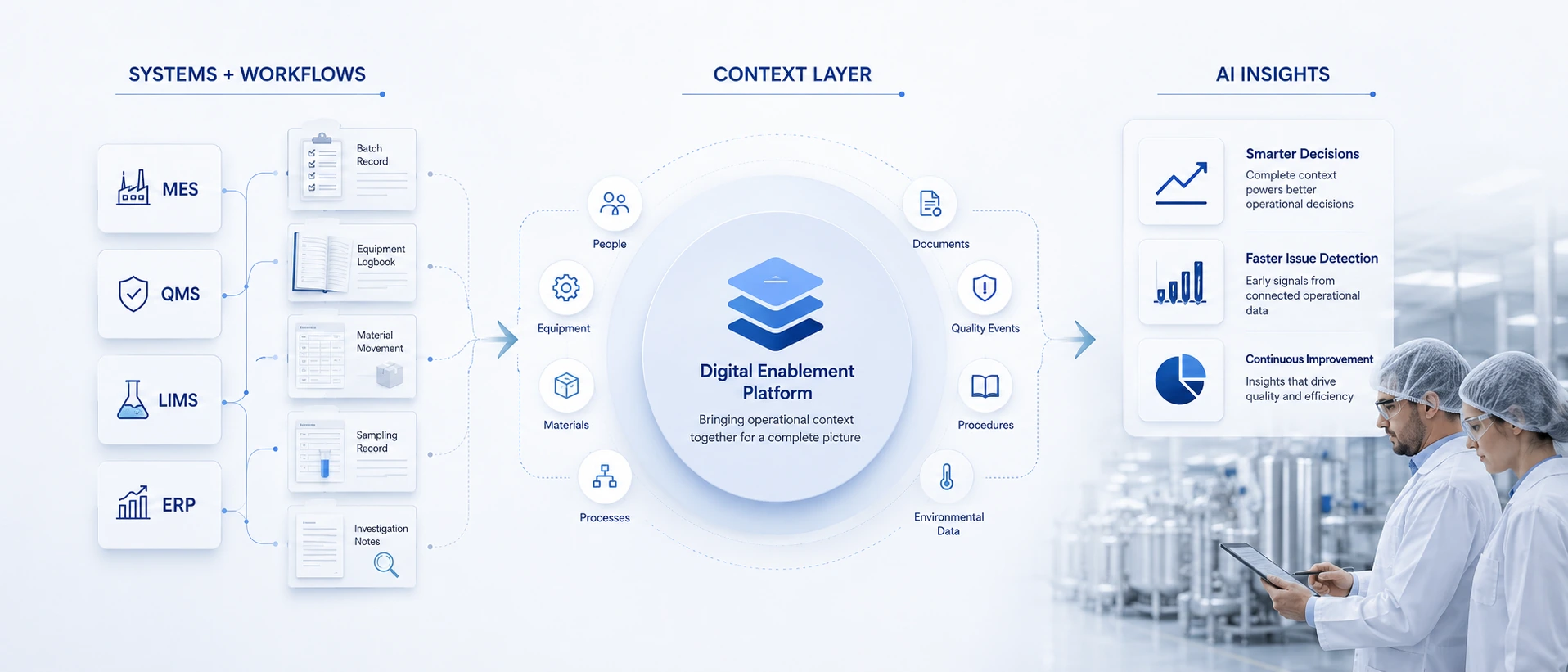
AI Needs Operational Context
Artificial intelligence (AI) is becoming a major focus in pharma manufacturing. Manufacturers are looking at AI to improve planning, reduce delays, support investigations, identify trends, and make better decisions across operations.
The opportunity is real. But there is also a challenge that does not get enough attention. AI is often applied where the context is incomplete.
Many manufacturers already have strong automation systems, transactional systems, and enterprise platforms. They have data from MES, ERP, LIMS, QMS, CMMS, BMS, historians, PLCs, SCADA systems, and other sources that support production, quality, laboratory testing, maintenance, facilities, inventory, planning, and execution.
That data is valuable, but it does not always tell the full story. A lot of the information that connects planning, scheduling, quality, inventory, sampling, investigations, materials, and execution still lives in records, forms, notes, checklists, emails, spreadsheets, logbooks, and manual workflows.
That missing operational context matters. Without it, AI may see the transaction but not the reason behind it. It may see the result but not the workflow that led to it. It may see the delay but not the handoff, exception, room status, material issue, quality concern, or manual decision that caused it.
For AI to be useful in GMP manufacturing, it needs more than access to data. It needs context.
Industrial AI Is a Context Problem
Many conversations about AI focus on the model. Which model is best? Which agent can reason better? Which tool can analyze faster? Which prompt gives the best answer? Those questions matter, but they are not the whole challenge.
In industrial and pharmaceutical manufacturing environments, the harder problem is often helping AI understand what the data actually represents. Code has structure, syntax, and validation rules. If code breaks, there are often clear ways to test whether it works.
Manufacturing data is different. It is messy, distributed, site-specific, and constantly changing. It comes from multiple systems, many vendors, many decades of decisions, and many local workflows. Some of it is structured. Some of it is handwritten. Some of it lives in comments. Some of it is buried in spreadsheets. Some of it is known only by the operators and supervisors who work in the process every day.
The limitation is often not the intelligence of the model. The limitation is whether the model understands the meaning and relationships behind the data. That is why operational context matters.
Raw Data Alone Is Not Enough
A pressure reading, temperature value, vibration signal, inventory transaction, sample result, or work order status can be useful. But by itself, it may not mean very much.
A temperature of 95°C could be normal in one process and a serious issue in another. A delayed sample could be a lab issue, a collection issue, a transfer issue, a material availability issue, or a scheduling issue. A material may appear available in a system, but still be physically staged in the wrong area. A piece of equipment may not be in use, but it may also not be ready. A deviation may be recorded in QMS, but the supporting timeline may live in shift notes, cleaning records, room checks, equipment logs, and operator observations.
AI cannot reliably interpret these situations from raw data alone.
It needs to understand the relationships around the data:
- What equipment is involved?
- What room or process does it support?
- What batch, lot, sample, material, or order is connected?
- What status matters for this workflow?
- Which system owns the official record?
- Which manual workflow captured the missing detail?
- Which version of the process was active at the time?
- Which exception, comment, or review step changed the meaning?
Data without context is difficult for people to interpret.
It is also difficult for AI to interpret.
Entity Resolution Is a Core Challenge
One of the biggest challenges in AI analytics is mapping a user’s question to the right entities in the data. When someone asks, “Which batch had the most quality issues?” the question sounds simple. But the system needs to understand what “batch” means, where batch data lives, how quality issues are defined, which records are included, which site or time period applies, and whether the data is current.
The same challenge appears in questions like:
- Which room caused the most delays?
- Which lot is waiting on disposition?
- Which material movements are not reconciled?
- Which samples are delayed?
- Which equipment had the most downtime?
- Which investigation has missing supporting documentation?
- Which cleaning records are still pending review?
Each question depends on entities.
The AI needs to understand the difference between a room, line, equipment asset, material, pallet, lot, sample, batch, order, deviation, cleaning record, and workflow status.
It also needs to understand how those entities relate.
A lot may relate to a batch. A sample may relate to a lot. A room may relate to a process step. A cleaning record may relate to room readiness. A material movement may relate to inventory availability. An investigation may relate to several supporting records across operations.
This is a semantic problem, not just a reasoning problem.
AI cannot reliably answer operational questions if it does not understand what the entities are and how they connect.
Documentation Is Often Not Enough
In theory, documentation should explain the process. In reality, documentation often lags behind operations.
P&IDs change. Equipment is modified. Procedures evolve. Control logic is updated. Local workarounds appear. Temporary processes become routine. Site-specific practices develop over time.
The plant changes faster than the documentation. That does not mean documentation is unimportant. It is essential.
But documentation is not always the best source of current operational context. In many facilities, the most accurate view of how work is actually happening lives in the systems and workflows people use every day. That includes enterprise systems, automation systems, logbooks, forms, checklists, investigations, sampling records, material movement records, shift handovers, and daily checks.
For AI, the challenge is not simply reading documentation. The challenge is reconstructing operational context from the systems and workflows that reflect current reality.
Systems of Record Matter, But They Do Not Tell the Whole Story
Operational systems often contain the most current data because teams use them every day. Examples include:
- MES for manufacturing execution
- QMS for deviations, CAPAs, and quality events
- LIMS for lab testing and sample results
- ERP for inventory, purchasing, and business transactions
- CMMS for maintenance activity
- BMS for facility monitoring
- Historians for process and automation data
- PLCs and SCADA systems for control and operating data
These systems are critical. They are often the best source of truth for the data they own. But they are not always designed to capture every surrounding workflow.
A QMS may manage a deviation, but not every supporting operator statement, room check, cleaning record, or shift observation.
A LIMS may manage the sample result, but not all the context around collection, transfer, and field observations.
An ERP may manage inventory, but not every local material movement, pallet staging event, or temporary hold.
A CMMS may manage a work order, but not every operator observation that happened before the issue was opened.
An MES may manage core execution, but not every readiness checklist, room log, manual check, or supporting operational workflow. This is not a failure of those systems. It is a reality of complex operations. Each system has a purpose. The challenge is the white space between them.
The Ideal Data Model Is Difficult to Achieve
A common AI strategy is to create a perfect data architecture first. Standardize everything. Build a canonical data model. Create a clean ontology. Harmonize all systems. Govern a small number of approved datasets. Then deploy AI.
That vision makes sense.
Canonical data models are valuable because they reduce ambiguity. They create consistency. They make analytics easier. They give teams common definitions. But industrial environments rarely start from a clean slate.
They often contain:
- Legacy systems
- Multiple vendors
- Site-specific processes
- Custom integrations
- Historical design decisions
- Duplicate data sources
- Local spreadsheets
- Manual workflows
- Different naming conventions
- Different definitions across departments
Trying to rebuild the entire data landscape before delivering value can become expensive, slow, and organizationally difficult. Many facilities cannot wait for perfect architecture.
The better question is not, “How do we fix every system first?” The better question is, “How do we add the missing context around the systems we already have?”
Contextualization Is the Practical Path Forward
AI should adapt to the operational reality of the plant. The plant should not have to stop everything and rebuild itself for AI. That is why contextualization matters. Contextualization turns data into meaning.
It helps translate:
- Tags into equipment
- Events into workflows
- Records into process context
- Systems into operational relationships
- Transactions into real-world activity
- Manual entries into structured data
- Comments and exceptions into usable signals
This context layer becomes the foundation for trustworthy AI analytics and future AI agents.
Without it, AI may have access to many data sources but still misunderstand what is happening.
With it, AI has a better chance of answering practical questions correctly.
Where a Digital Enablement Platform Fits
A Digital Enablement Platform, or DEP, helps capture the operational workflows that often sit between people, paper, equipment, materials, and enterprise systems.
A DEP is not meant to replace MES, QMS, LIMS, ERP, CMMS, BMS, historians, PLCs, or SCADA systems. Those systems remain important. A DEP complements them by digitizing the workflows that often surround them. It helps turn paper-based and disconnected records into structured, audit-ready operational data.
That can include:
- Electronic logbooks
- Digital GMP forms
- Room cleaning records
- Equipment status workflows
- Sampling coordination records
- Material movement workflows
- Pallet tracking
- Lot readiness checklists
- Lot release support records
- Investigation support documentation
- Shift handover records
- Daily checks and inspections
- Line clearance and room readiness records
- Manual data entry workflows
The value of a DEP is not simply that it removes paper.
The value is that it captures missing operational context in a format that can be searched, reviewed, connected, and analyzed.
Connecting Manual Workflows With System Data
The real opportunity for AI is not choosing between manual workflow data and system data. It is bringing them together. Manufacturers already have important data in their enterprise systems. They also have important context in the work people perform every day. A DEP helps connect those worlds.
For example:
- A material movement workflow can add physical location context around ERP inventory data.
- A sampling coordination workflow can add collection and transfer context around LIMS testing.
- An investigation support workflow can add operational evidence around a QMS deviation.
- A room readiness checklist can add status context around production scheduling.
- A cleaning verification workflow can add readiness context around batch execution.
- A shift handover record can add human and operational context across teams.
- An equipment status workflow can add operator observations around CMMS or maintenance activity.
This is where AI becomes more practical. Instead of analyzing system data in isolation, AI can work with a more complete picture of the operation. It can see not only what happened, but more of the surrounding context that explains why it happened.
Practical Examples of Context for AI
Consider a delayed batch start.
A system may show that the batch started late. But the delay could be related to room cleaning, material staging, equipment readiness, sampling, staffing, quality review, or an open investigation.
If those details are stored in paper records or disconnected notes, the pattern may be hard to see.
A DEP can capture those readiness activities in a structured way.
Over time, the organization can understand whether delays are tied to specific rooms, materials, equipment states, review bottlenecks, or recurring handoff issues.
Now consider a deviation investigation.
The QMS may contain the official deviation record, but the supporting context may come from shift notes, equipment checks, cleaning records, sampling records, material movements, and operator observations.
If that context is digitized and searchable, investigators can reconstruct the event faster and with more confidence.
Now consider material movement.
ERP may show inventory status, but local teams may still need to track temporary movements, staging, holds, transfers, and pallet location across a building.
If those movements are captured digitally, teams gain better operational visibility. AI and analytics can then identify patterns that would be difficult to see from ERP transactions alone.
Now consider sampling.
LIMS may show when a result was available, but it may not explain collection delays, transfer issues, field observations, or missing supporting checks.
A DEP can capture the workflow around sample collection and movement, giving the result more context.
These are not futuristic use cases.
They are practical examples of how better context improves decisions.
Why This Matters for AI Agents
The same context problem becomes even more important when organizations begin discussing AI agents.
An agent cannot safely recommend actions, diagnose issues, coordinate work, or automate decisions unless it understands operational context. If an agent does not know what equipment is involved, what status matters, which room is affected, which batch or lot is connected, what system owns the record, and which workflow step is pending, then its recommendation may be incomplete or wrong.
Agentic operations depend on context. Before AI can coordinate work, it needs to understand the work. That means the organization needs a reliable way to capture, structure, and connect operational context.
A DEP helps provide that foundation by digitizing the manual workflows that often contain the missing details.
Why This Matters for AI Readiness
AI readiness in pharma manufacturing is often discussed as a technology challenge. But in many cases, it is really a data and workflow challenge. The question is not only whether the organization has data. The question is whether the organization has the right data, with the right context, in a format that can be trusted and used.
A strong AI foundation requires data that is:
- Structured
- Contextual
- Searchable
- Traceable
- Reviewable
- Connected
- Audit-ready
- Consistent across workflows
Manual workflows often contain valuable context, but paper makes that context difficult to use. A DEP helps close that gap. It captures operational activity at the point of work and turns it into structured data that can support reporting, investigations, continuous improvement, and future AI use cases.
AI Value Starts With Better Operational Visibility
The fastest path to AI value is not always a large transformation project.
In many cases, value starts by digitizing the workflows that already matter: room readiness, material movement, sampling coordination, leaning verification, shift handovers, investigation support, lot readiness, daily checks.
These workflows happen every day. They already influence quality, schedule adherence, inventory flow, and operational decision-making.
When they remain manual, the organization loses visibility, but when they are captured through a DEP, they become part of the digital manufacturing data foundation. That creates a more complete view of operations, and AI performs better when it has a more complete view.
Where OpsTrakker Fits
OpsTrakker is a Digital Enablement Platform built for GMP operations.
It helps pharma manufacturers digitize workflows that still live in paper, binders, spreadsheets, and disconnected tools, especially the operational records that sit between enterprise systems.
OpsTrakker helps capture context from workflows such as:
- Electronic logbooks
- GMP forms and checklists
- Investigation support documentation
- Material and pallet movement tracking
- Sampling coordination
- Lot release and lot disposition support
- Room cleaning records
- Cleaning verification forms
- Line clearance and room readiness
- Electronic signatures, where required
- Daily checks
- Equipment status and lifecycle workflows
- Manual data entry workflows
- Shift handover records
The goal is not to replace existing systems, but to capture the context those systems do not always reach.
By digitizing these workflows, OpsTrakker helps manufacturers create structured, audit-ready operational data that can support compliance today and AI readiness tomorrow.
The Path Forward
AI will continue to grow in pharma manufacturing, but the manufacturers that benefit most will not be the ones that simply add AI on top of incomplete data. They will be the ones that connect system data with operational context.
That is where the real opportunity is. Many manufacturers already have strong automation and transactional data. They also have valuable operational context in the manual workflows people use every day. A Digital Enablement Platform helps bring those worlds together. When operational context is connected to system data, AI has a much more complete picture of what is happening. And when AI has a more complete picture, it has a much better chance of delivering value.
Learn How OpsTrakker Can Kickstart your AI Projects
Explore how OpsTrakker can help your team replace paper logbooks, forms, and checklists with digital workflows designed in GMP operations.