GMP Workflows Most Systems Miss
Pharma manufacturers have invested heavily in digital systems.
MES, QMS, LIMS, CMMS, BMS, ERP, historians, and other platforms all play important roles in modern manufacturing operations. They help manage production, quality events, laboratory data, maintenance, facilities, materials, inventory, and business processes.
These systems matter.
But even with strong enterprise systems in place, a surprising amount of daily GMP work still happens on paper, in binders, in spreadsheets, through email, or in disconnected tools.
That does not always mean a company is behind on digital transformation.
In many cases, these workflows sit in the white space between larger systems.
They may be too local for an enterprise platform. Too operational for a quality event system. Too specific for an ERP transaction. Too procedural for a laboratory system. Too cross-functional to fit cleanly into one system owner’s roadmap.
But they are still important.
They are the records that show what happened, who performed the activity, what material, room, lot, sample, or equipment was involved, whether the task was reviewed, and whether any follow-up was needed.
That is where a Digital Enablement Platform, or DEP, provides value.
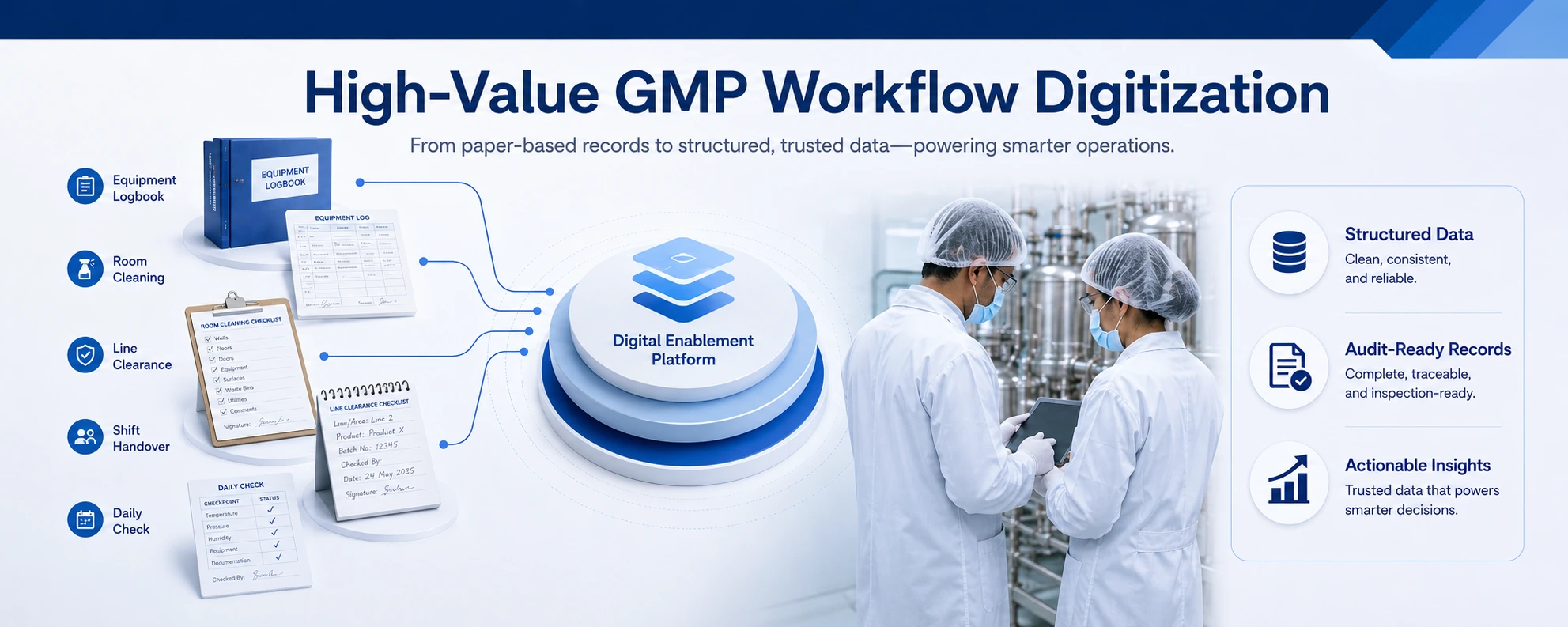
A DEP helps manufacturers digitize the everyday GMP workflows that often sit between people, paper, equipment, materials, and enterprise systems. These workflows may look routine individually, but together they form a critical layer of operational data.
This is not a replacement article. It is a reach article. Enterprise systems do what they are designed to do, while a DEP helps capture the GMP workflows that still happen around them.
What Is GMP Workflow Digitization?
GMP workflow digitization is the process of turning manual, paper-based, or disconnected GMP activities into controlled digital workflows.
It is not the same as scanning a form.
It is not just creating a PDF.
It is not simply moving a paper record into a shared folder.
True GMP workflow digitization means capturing the activity in a structured, traceable, and reviewable format. The record should preserve the right context, including user, time, process, material, room, equipment, lot, status, review, and exception information.
A digitized GMP workflow should help teams answer practical questions:
- Was the task completed?
- Who completed it?
- When was it completed?
- Was the right equipment, room, or process selected?
- Was the record reviewed?
- Were there exceptions?
- Is the record searchable?
- Can the data be trended or analyzed later?
That is the difference between digitizing paper and creating structured manufacturing data.
Why Paper Still Lives in High-Value GMP Workflows
Paper persists because it is flexible.
A paper form can be created quickly. A binder can be placed beside a process. A spreadsheet can be adjusted by a local team. A checklist can be updated for a room, line, material flow, or site-specific procedure.
That flexibility is why paper often survives in GMP workflows such as:
- Investigation support documentation
- Material and pallet movement tracking
- Sampling coordination
- Lot release support records
- Lot disposition checklists
- Room cleaning records
- Cleaning verification forms
- Line clearance checks
- Manual quality checks
- Maintenance support records
- Operator observations
The problem is that flexibility comes with tradeoffs.
Paper is difficult to search. Handwriting can be hard to read. Entries may be incomplete. Records can be reviewed late. Information is hard to connect across departments. Data is difficult to trend across rooms, lots, samples, assets, shifts, and sites.
Most importantly, paper limits visibility.
The record may exist, but the data is often trapped.
Use Case 1: Investigation Support Documentation
QMS platforms are typically the system of record for deviations, investigations, CAPAs, and quality events.
But the investigation itself often depends on operational context that sits outside the QMS.
A deviation record may answer what event was opened and how it was dispositioned. But the team still needs supporting information from the floor, the lab, the warehouse, maintenance, cleaning records, shift notes, room logs, equipment checks, and operator observations.
When that supporting information lives on paper, investigation work becomes harder than it needs to be.
Teams may need to locate binders, scan documents, chase signatures, interpret handwritten notes, and manually reconstruct the timeline.
A DEP can help capture investigation support documentation in a structured workflow.
For example, a digital investigation support record can capture:
- Event or deviation reference
- Area, room, equipment, sample, lot, or material involved
- Timeline of observed events
- Operator or supervisor statements
- Supporting checks performed
- Related cleaning or line clearance records
- Photos or attachments, where appropriate
- Follow-up actions
- Exceptions or comments
- Review and approval status
- Audit trail
This does not replace QMS.
It gives the QMS process better operational context.
The value is simple: when an investigation begins, the supporting records are easier to find, easier to review, and easier to connect to what happened
Learn more about how you can replace your Investigation Support Documentation with OpsTrakker eForms
Use Case 2: Material and Pallet Movement Tracking
ERP systems are often used to manage inventory, materials, purchasing, and financial transactions.
But not every physical movement inside a facility is captured cleanly in ERP.
In real operations, teams may need to track when materials move from one room to another, when pallets are staged, when containers are transferred, when materials are held, when items are returned, or when temporary movements occur between process steps.
Some of those events may be too granular, too local, or too operational to justify a full ERP transaction.
When that happens, teams often rely on paper logs, spreadsheets, whiteboards, or email updates.
That creates risk.
Material location may be unclear. Status may be outdated. A pallet may be staged in the wrong area. A hold may not be visible to the right team. Records may need to be reconciled manually later.
A DEP can digitize material and pallet movement workflows without forcing every operational step into ERP.
This gives teams a controlled way to manage the physical reality of materials moving through a facility.
ERP still remains important.
The DEP fills the local workflow gap where physical movement, operational status, and GMP documentation need to be captured in a practical way.
Learn more about how you can digitize Material and Pallet Movement Tracking with OpsTrakker eForms
Use Case 3: Sampling Coordination and Sample Tracking
LIMS platforms are used to manage laboratory testing and sample results.
But many sampling workflows begin before the sample reaches the lab.
Teams may need to coordinate where a sample is taken, who took it, when it was collected, what room or lot it came from, how it was labeled, whether it was transferred correctly, and whether any supporting field observations were recorded.
If the LIMS does not cover the full sampling workflow at the point of collection, teams may rely on paper sample forms, spreadsheets, printed labels, manual logs, or email coordination.
That creates gaps.
The lab may receive the sample, but the operational context around collection may be incomplete or difficult to retrieve.
A DEP can help digitize the sampling workflow before and around LIMS.
A digital sampling record can capture:
- Sample ID
- Lot or batch reference
- Sampling point
- Room or equipment context
- Collection date and time
- Person collecting the sample
- Required checks before sampling
- Chain of custody or transfer details
- Field observations
- Exceptions
This does not replace LIMS testing.
It strengthens the workflow around sampling so the sample is supported by better context from the point of collection.
Use Case 4: Lot Release and Lot Disposition Support
Lot release and lot disposition are often cross-functional processes.
Quality, manufacturing, warehouse, laboratory, planning, and operations may all need to provide input before a lot can move forward.
Some of the final disposition may be managed in QMS, ERP, MES, LIMS, or another controlled system. But the supporting checklist often spans many areas.
Teams may need to confirm that records are complete, samples are accounted for, deviations are reviewed, cleaning records are available, material movements are reconciled, and open issues are understood.
If that checklist is managed manually, the process can become slow and fragmented.
A DEP can digitize lot release support and lot disposition readiness workflows.
A digital workflow can capture:
- Lot number
- Product or material
- Required documents
- Open deviations or investigations
- Sampling status
- Testing status reference
- Material movement status
- Cleaning or room readiness records
- Required department sign-offs
- Exceptions
- Final review status
This creates a clearer view of lot readiness.
The DEP does not need to become the official system of disposition if another system already owns that decision. Instead, it can manage the operational checklist and supporting evidence that help teams get to the decision with fewer delays.
Use Case 5: Line Clearance and Room Readiness
Line clearance and room readiness workflows are common examples of GMP activities that are often handled through checklists.
The process may confirm that previous materials were removed, labels were cleared, equipment is clean, the room is ready, documentation is available, and the area is prepared for the next activity.
Because the workflow is procedural, it is a strong candidate for digital execution.
This helps make the execution of the procedure more consistent.
It also makes the record easier to review and easier to retrieve later.
Use Case 6: Cleaning Records and Verification Forms
Cleaning records are another high-value use case for a DEP.
Cleaning activities may involve rooms, equipment, utensils, tools, or process areas. The documentation may need to show what was cleaned, when it was cleaned, who performed it, what cleaning agent was used, and who verified the result.
A paper cleaning logbook may support basic documentation, but it is hard to trend and hard to connect to other records.
This makes the record easier to complete, review, retrieve, and analyze.
It also helps teams understand cleaning history across areas, assets, or sites.
Learn more about how you can digitize Cleaning Records and Verification Forms with OpsTrakker eLogBook
How a DEP Connects the White Space Between Systems
A Digital Enablement Platform is most valuable when it captures the operational work that happens around enterprise systems.
It does not need to replace MES, QMS, LIMS, CMMS, BMS, ERP, or historians.
It complements them.
A DEP can help capture the GMP context those systems may not fully manage on their own.
For example:
- Investigation support workflows can provide better context around QMS events.
- Sampling workflows can support the process before and around LIMS testing.
- Material movement workflows can capture physical movement details that may not belong in ERP.
- Cleaning and line clearance records can support production readiness.
- Shift handovers can improve operational continuity.
- Daily checks can support dashboards, reporting, and trending.
- Equipment status workflows can support maintenance and operational readiness.
This is the white space where many organizations still rely on paper.
It is also where a lot of practical operational data is created.
A DEP helps make that data structured, searchable, and useful.
Why These Workflows Matter for Data Integrity
Data integrity is not only about large systems.
It starts with the records people complete every day.
If a paper logbook is incomplete, illegible, reviewed late, or difficult to retrieve, it creates risk. If a spreadsheet is updated without the right controls, it creates risk. If a form relies heavily on free-text entries, it may be difficult to trend or interpret later.
A Digital Enablement Platform can help improve data integrity by standardizing how records are created and managed.
- Required fields
- Controlled inputs
- Time and user attribution
- Review and approval workflows
- Audit trails
- Record status visibility
- Searchable historical records
- Consistent form design across workflows
- Exception handling
- Electronic signatures, where required
These controls help make records more complete, more consistent, and easier to defend.
That matters during audits.
It also matters during daily operations.
Why These Workflows Matter for AI Readiness
AI readiness is often discussed at a high level.
But in manufacturing, AI depends on the quality of the operational data underneath it.
If critical information is still trapped in paper logbooks, handwritten notes, spreadsheets, and disconnected forms, the organization may not have the data foundation needed to support useful analytics or AI.
This is why GMP workflow digitization matters.
Investigation support records, sampling workflows, material movement logs, lot readiness checklists, cleaning records, line clearance checklists, shift handovers, and daily checks all contain valuable operational context.
They can show patterns across materials, rooms, equipment, lots, samples, shifts, processes, and sites.
But only if the data is captured in a structured way.
A DEP helps prepare organizations for analytics and AI by capturing operational data with the context needed to make it useful.
That means data is not just stored.
It is organized.
It is connected to the right workflow.
It can be searched, reviewed, trended, and analyzed.
Where OpsTrakker Fits
OpsTrakker is a Digital Enablement Platform built for GMP operations.
It helps pharma manufacturers digitize workflows that still live in paper, binders, spreadsheets, and disconnected tools, especially high-value operational records that other systems often do not touch.
OpsTrakker supports practical GMP workflow digitization across areas such as:
- Investigation support documentation
- Material and pallet movement tracking
- Sampling coordination
- Lot release and lot disposition support
- Room cleaning records
- Cleaning verification forms
- Line clearance checklists
- Shift handover records
- Daily checks
- Manual data entry workflows
- Equipment status and lifecycle workflows
- Operational forms and checklists
The goal is not just to replace paper.
The goal is to capture structured, audit-ready operational data at the point of work.
That gives teams better visibility into what is happening across manufacturing operations. It also creates a stronger foundation for compliance, review, reporting, investigations, continuous improvement, and future AI readiness.
For many organizations, the biggest digital transformation opportunities are not always the largest systems.
They are the daily GMP workflows that still happen in the spaces between them.
OpsTrakker helps capture that space.
Key Takeaways
High-value GMP workflows often remain on paper because they are local, procedural, cross-functional, site-specific, or spread across multiple systems.
A DEP is valuable when dedicated systems do not fully cover the operational workflow around quality, sampling, inventory movement, lot readiness, cleaning, line clearance, shift handover, and daily checks.
A Digital Enablement Platform helps capture these workflows in a structured, controlled, and audit-ready format.
DEP workflows complement enterprise systems by capturing the operational context that often sits around them.
OpsTrakker helps pharma manufacturers digitize the GMP white space that other systems often do not touch, turning routine operational records into structured manufacturing data.